Friday, 16 August 2013

No, not him. Or him.

   When I saw a book in the library with 'Charley Harper' on the spine, straight away I thought of this guy
.http://uksubstimeandmatter.net/gallery/albums/userpics/normal_chpolsk2.jpg... the ageing punk rock idol. Somebody younger might have thought of this guy...
http://cdn.bleacherreport.net/images_root/slides/photos/001/277/692/1288546236712_f1_display_image.jpg?1315512497..Charlie Sheen's saner alter ego from 'Two and a half men'.
   In fact it was about an American artist I'd never heard of, who created amazing pictures of wildlife. They are often stylised and angular, but they look fantastic. I love them.http://www.lifeofanarchitect.com/wp-content/uploads/2011/12/Charley-Harper-Snowy-Egret.jpghttp://media.treehugger.com/assets/images/2011/10/harper2.jpg
 http://moldychum.typepad.com/moldy_chum/images/2008/06/03/1070724364_298db53859.jpghttp://shhsgraphicdesign.wikispaces.com/file/view/charles-harper-raccoons-doecdoe-blogspot-com.jpg/373757554/800x592/charles-harper-raccoons-doecdoe-blogspot-com.jpg
http://designythings.files.wordpress.com/2013/03/charley-harper-by-motaw13b.jpg?w=560http://i.telegraph.co.uk/multimedia/archive/01181/arts-graphics-2007_1181154a.jpg
Piranhas eating cows, anacondas crushing jaguars, raccoon muggers - all simplified yet not diminished.http://cdn.shopify.com/s/files/1/0187/1722/products/CH_illustratedlife_05_1024x1024.jpg?2282

Tuesday, 13 August 2013

Big ships have little ships...


File:MightyServantRoberts19882turned.jpg
The American frigate Samuel B. Roberts being carried on board the heavy lift ship Mighty Servant 2.

Monday, 12 August 2013

Black Ajax


  http://www.threedonia.com/wp-content/uploads/2012/01/boxer.jpg    
  

    George Macdonald Fraser is famous for his Flashman series, the fictional adventures of Tom Brown's bullying nemesis as he gets inadvertently involved in pretty much every notable incident in 19th century history. I'm a huge fan of these stories; they are historically accurate - I've learned a lot from from reading them - and very funny.

    His best book though, in my eyes, is set in 1810, and Flashman doesn't get a look in - though his father does. It's the true story of a black ex - slave called Tom Molyneux, who made his way to these shores with the intention of fighting Tom Cribb, champion of England. Which meant the world, back then.

    Boxing - bare knuckles in those days -  was as big a national obsession as football is now. Though illegal, it was followed be everyone, from the King on down. Prize fights would be organised in secret, and thousands of spectators would swoop on some lonely bit of countryside, preferably where several counties met, to facilitate escape should the law arrive.

  After battering a couple of lesser pugs in fine style, Molyneux eventually had his fight with Cribb. It was a close run thing, with many thinking, then and now, that Molyneux was gypped out of the title by sharp practice and biased refereeing. Nobody wanted a foreigner to lift the crown, let alone a black one. There was a rematch, but by then Molyneux's penchant for drinking and womanising had caught up with him and he was roundly thrashed. He died of liver failure eight years later in Galway.

   What I love about this book is the astonishingly vivid description of Georgian London in its boozy, violent heydey. So much more fun than the grim grey puritanical hell the victorians made. Sometimes a single novel can spark off a lifetime's fascination with an area or a historical period. A book called 'The Kings of Vain Intent', abouth the third crusade, got me obsessed with the crusades and the history of the eastern mediterranean. And this is the book that sparked my passion for the georgian era.

   There's a local connection too. Lord Alvanley, one of the Prince Regent's sporting cronies, was sort of a local lad. He was one of the Arden family, who owned Arden Hall in Bredbury and Underbank Hall - now a Natwest bank - in Stockport. Trying to keep up with Prinny's spending meant that he had to sell the family estate pretty much as soon as he inherited it, though.http://ep.yimg.com/ca/I/yhst-41693642061643_2267_1837996


    This is a painting of the Fives Court, where the sporting set gathered. Molyneux is the black guy stripped to the waist in the centre.

Stuffing; not just for Turkeys

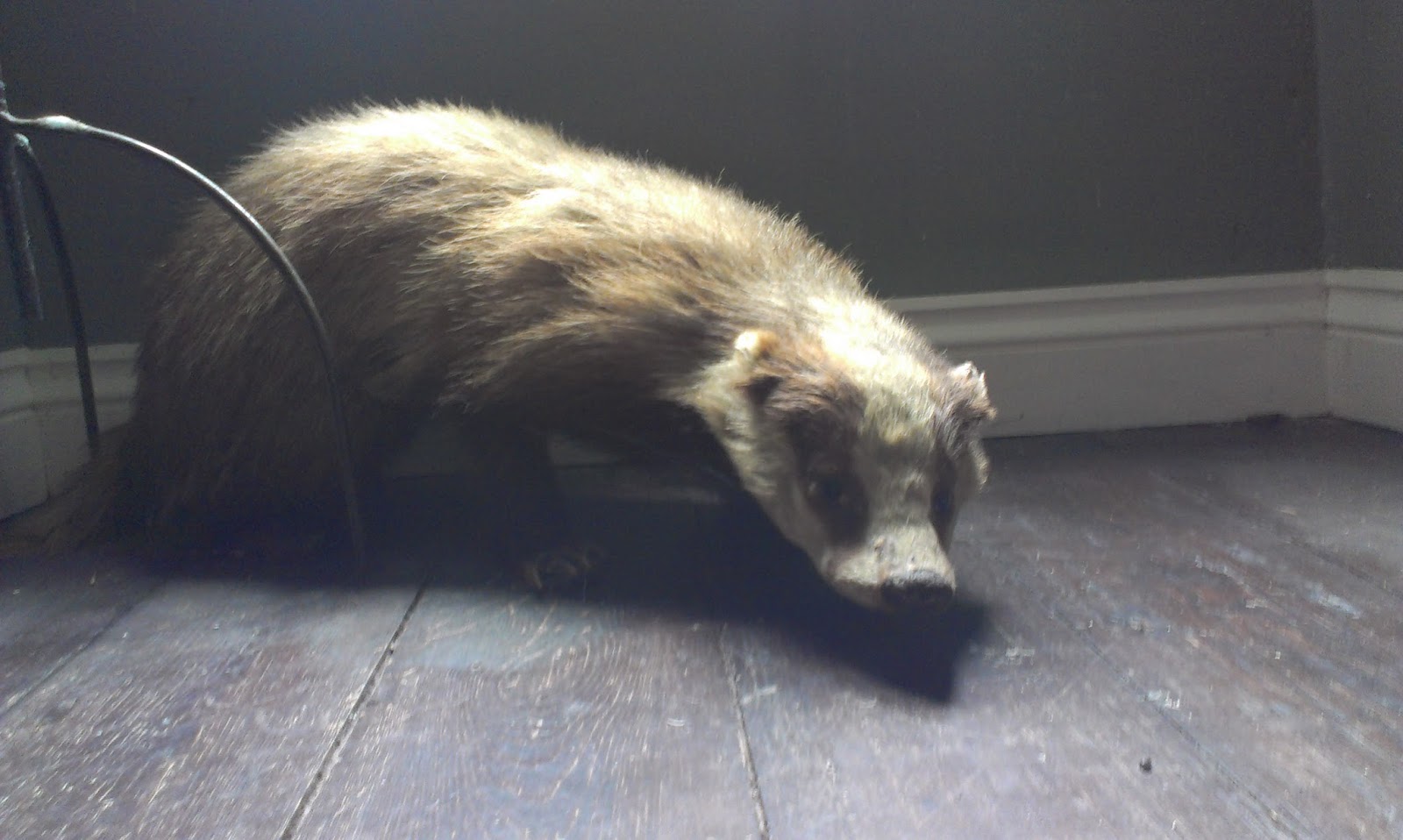
The creepy stuffed animals from my sister's house in Yorkshire.


Friday, 9 August 2013

Black and White

   Half - timbered buildings fascinate me. They epitomise Old England, and the english yearning for a rural past that, in truth, wasn't much fun to live in. No plumbing, no heating, chuck the contents of your chamberpot out of the window...no thanks.
   I once spent a week in a half - timbered farmhouse in Wales. The floors weren't level. Every room as on a different level from every other room. There were narrow, twisty staircases in odd places. And I banged my head on roof beams and door jambs ten times a day. Nicer to look at than to live in, I'll admit.
   Apart from the link with history, though, it's the contrast between the black timberwork and  the white plaster that catches my attention. Most of the survivors are pretty high - status buildings, and the designers went overboard with the decoration. So the timbers form complex geometric shapes
   There's loads of examples round here. Bramall Hall, Baguley Hall, Wythenshawe Hall, the Shambles in Manchester, and a few miles further south, the all - time classic, Little Moreton Hall
http://onthetudortrail.com/Blog/wp-content/uploads/2012/04/350px-Little_Moreton_Hall.jpg http://www.mikejs.com/pics/2002/moreton_hall/07_hall_roof.jpg    Some of these buildings only date from the 1500's. Timber was cheaper than stone, so these primitive structures were thrown up long after there were more durable alternatives. And yet they age very well. The timbers warp and sag, but the buildings still stand.
   Such is their magic that Mock Tudor has become an architectural style in its own right.In Speke, near Liverpool, there are mock tudor houses with thatched roofs that can't be more than 90 years old.
Thatched roofs! That's what I mean about the yearning for the past. Though with toilets, obviously.
http://mw2.google.com/mw-panoramio/photos/small/793459.jpg                http://www.lisburneschool.ik.org/img/bramall_hall.jpg

Thursday, 1 August 2013

Fort Nelson

http://www.royalarmouries.org/assets-uploaded/images/source/Fort.jpg  


    Once upon a time, we were afraid of invasion. From the French.
   So in 1859 the prime minister, Lord Palmerston, commissioned a series of forts to defend the navy's main anchorage at Portsmouth. These huge structures still stand, surrounded by suburban houses or looming over thhe town on Portadown hill. And one of them, Fort Nelson, has been restored. It's in the hands of the Royal Armouries, and it's where they keep the big guns. The one at the top is one of two Mallett's Mortars. With a calibre of 914mm - about three feet - it shares with the American Little David mortar the title of biggest gun ever.

http://www.countycaterers.co.uk/wp-content/uploads/2013/01/Fort_Nelson_2.jpg       The fort's guns weren't trained on the harbour. The worry was that the sneaky French wouuld land further down the coast and attack the anchorage from the landward side. So the forts effectively defend Portsmouth from the rest of England. Of course by the time they were finished, at stupendous cost, the threat had vanished - courtesy of the Germans, ironically, after their victory in the Franco - Prussian war. So they became known as 'Palmerston's follies'. Defence procurement foul - ups aren't just a modern phenomenon.
   Entry is free - as it is to the other Royal Armouries outbase at Leeds. Well worth a visit.